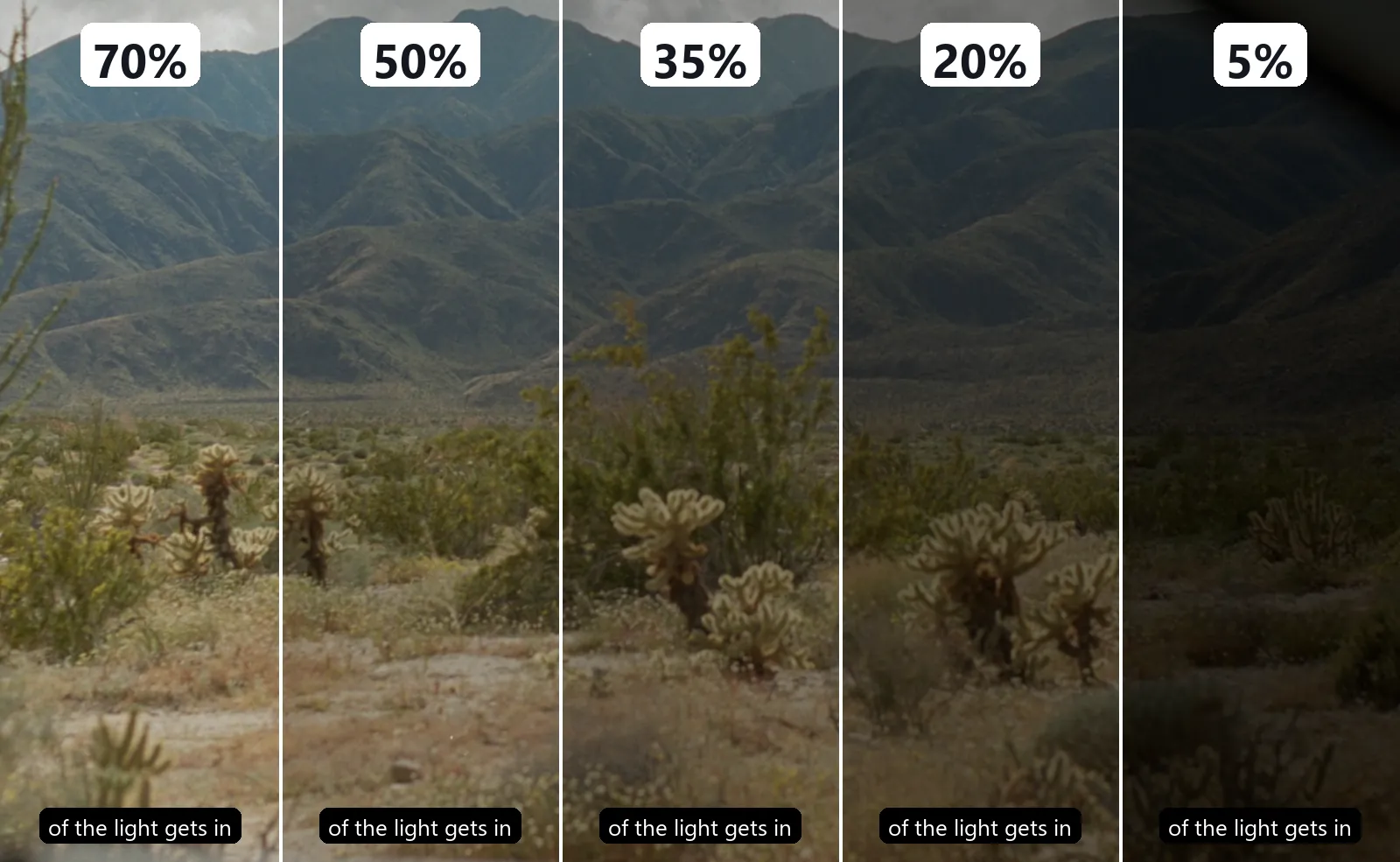
Quick answer: Window tint percentages tell you how much visible light gets through the glass. 70% tint is nearly clear, 50% is light, 35% is medium, 20% is dark and 5% is “limo” dark. The lower the number, the darker the window. In Utah, front side windows must let in at least 35%, and rear windows can be any shade.
I’ve fitted window film on 300 jobs since 2022, and these days that’s homes, businesses and cars from Nephi to Provo. I bring a case of tinted sunglasses to estimates so people can see a shade before they pick one. (You’re allowed to try on every pair, like it’s the spinning rack at a gas station.)
Below is what each percentage really looks like, what’s legal, and what the box doesn’t tell you. One of those things can get a “legal” 35% film a ticket.
On this page
- Window tint percentage chart
- What the numbers mean
- 70, 50, 35, 20 and 5 percent tint
- 35 vs 20 tint
- Legal window tint percentages
- Windshield tint
- Why the box number isn’t the meter number
- Darker isn’t cooler
- Tint at night
- Tint percentages for homes
- What we see on real jobs
- Questions people ask
Window tint percentage chart
A window tint percentage chart lists each shade by its visible light transmission, the share of light the window lets through. Here are the five shades most shops carry, what each looks like, and where each one is legal on a Utah car.
| Shade | What it looks like | Utah front side windows | Utah rear windows |
|---|---|---|---|
| 70% | Almost clear | Legal | Legal |
| 50% | Light smoke | Legal | Legal |
| 35% | Medium, you can see faces | Legal, right at the line | Legal |
| 20% | Dark, faces hard to see | Not legal | Legal |
| 5% | Limo, can’t see in | Not legal | Legal |
A chart like this is a dating profile. Every word of it is true, and it still leaves out the things you only find out over dinner. Here are the three it skips: what your factory glass adds, why a lighter film can be cooler, and what each shade does after dark.
What do window tint percentages mean?
Window tint percentages measure visible light transmission, or VLT. A 35% tint lets 35% of visible light through and blocks the other 65%. The International Window Film Association puts it the same way: a film with a VLT of 25 percent lets 25 percent of visible light pass.
The scale runs backwards, so a higher number means a lighter window. Plenty of people get this wrong once, usually right after telling a friend, with total confidence, that they’re “going 70% dark.” (The friend nods. The friend also doesn’t know.)
70 percent tint
70 percent tint lets in 70% of visible light, so it looks almost clear. It’s the shade for people who want heat and UV protection without a darker look, and it’s legal on every window in Utah.
Most people won’t notice it’s there. That can include the person who paid for it, who may walk out to the car and quietly wonder if anyone came at all.
The surprise is how much a light film still does. Clear and light films block UV just as well as dark ones.
Darker tints do not protect against UV rays any better than clear UV-protective film does.
Skin Cancer Foundation, Ask the Expert, July 2026
50 percent tint
50 percent tint lets in half the visible light. It reads as a light smoke from outside and cuts glare without making the car feel dark inside. It’s legal on every window in Utah.
50% is the medium salsa of window tint. You can tell something’s there, and nobody’s in tears. It suits drivers who are out a lot after dark but still want the car to look tinted.
35 percent tint
35 percent tint lets in 35% of visible light. It’s the go-to shade for front side windows here, because it’s the darkest you can run on the front doors in Utah, Idaho and Nevada. From outside, you can still make out the people inside.
You can tell someone’s in the car, but not whether they’re singing along to the radio. You definitely can’t tell if they’re doing the hand moves too. For most drivers, that’s exactly enough privacy.
How dark is 35 tint?
35 tint is a medium shade. In daylight you can see shapes and faces through it from outside, but not much detail. From inside, the view is clear in daylight and noticeably dimmer after dark.
On a real car, a 35% film usually meters darker than 35%, because the factory glass blocks some light too. That’s the ticket trap from the top of this post, and it’s explained below.
20 percent tint
20 percent tint lets in a fifth of the visible light. From outside, people inside are hard to see. Many SUVs and trucks come with rear privacy glass close to this shade: a GM service bulletin calls its privacy glass nominally 20%.
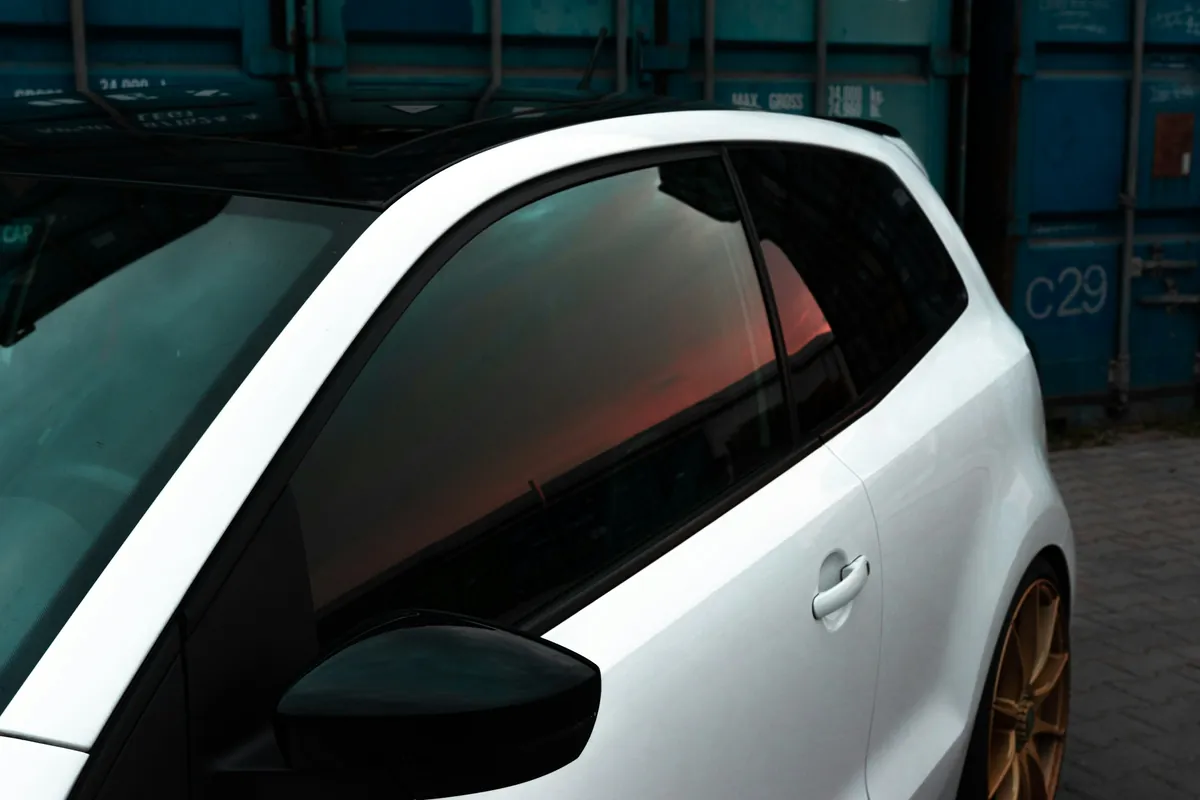
So if your SUV has dark rear windows, you’ve been a 20% tint customer for years and never paid a cent. Put 20% film over that glass and you get about 4%. That’s how a family minivan accidentally goes into the limo business.
In Utah, 20% is legal on the rear side windows and back glass, but not on the front doors.
5 percent tint
5 percent tint lets in only 5% of visible light. It’s called limo tint, and from outside the windows look black. In Utah it’s legal on rear windows only.
From the sidewalk, a 5% car looks like it’s carrying either a celebrity or a very important pizza. The catch is seeing out. Reversing at night through 5% back glass is mostly faith: you check the camera, then the mirrors, then you just listen really hard.
Plenty of drivers regret it. One owner on the Tesla Motors Club forum put it plainly: “I did 20% on driver/pass windows and 5% everywhere else. I regret it. Way too dark.”
35 vs 20 tint: which should you pick?
35% at night kind of looks like 20% during the day and 20% at night looks like 5% during the day
Ryan Mayer, 35% vs 20% vs 5% Window Tint, YouTube
Pick 35 for the front doors in Utah, because 20 isn’t legal there. Pick 20 for the rear windows if you want privacy and you’re fine reversing with less light. A common middle ground is 35 on the fronts and 20 on the rears.
The real decider is night driving. At noon, every shade looks like a genius decision. At 10pm on I-15, in the rain, with the wipers going, you meet the shade you actually bought.
If you want to compare 35 and 20 on your own car, book a free estimate. We come to your home or work and bring the samples.
Legal window tint percentages
Legal window tint percentages are set by each state, and they mostly control the front side windows. In Utah, front side windows must let in at least 35% of light, rear windows can be any shade, and no window can look mirrored.
Utah moved its front window limit from 43% to 35% in 2022, through Senate Bill 149. Some websites still say 43%. Those pages have aged like a carton of milk left on a dashboard in August. Here’s how Utah compares with its neighbors.
| State | Front side windows must let in at least | Source |
|---|---|---|
| Utah | 35%, with a 5% variance when metered | 41-6a-1635 |
| Idaho | 35%, plus or minus 3% | 49-944 |
| Nevada | 35%, with a 7% tolerance | 484D.440 |
| Arizona | 33%, plus or minus 3% | 28-959.01 |
| Wyoming | 28% | 31-5-962 |
| Colorado | 27% | 42-4-227 |
| California | 88%, clear film only | 26708 |
In Utah a tint violation is an infraction. The 2026 Uniform Fine Schedule suggests a $60 fine, and the ticket must be dismissed if you fix the tint within 14 days. That’s the state’s way of saying it isn’t angry, just disappointed.
One more rule people miss: any car with tinted windows needs outside mirrors on both sides.
Windshield tint percentages
Utah allows a tint strip across the top of the windshield, down to 4 inches or the AS-1 line, whichever is lower. Below that, the windshield must let in at least 70% of light. That matches the federal minimum under FMVSS 205.
That still leaves room for a clear heat-blocking film on the whole windshield, as long as the finished glass meters 70% or more. Anyone who parks facing west in July knows why people want it. By 4pm you could proof bread on the dashboard, and the seatbelt buckle has turned into a branding iron.
Why the number on the box isn’t the number on the meter
The percentage on the box describes the film on clear glass. Car glass already blocks some light, so the finished window meters darker than the film’s number. An officer’s meter reads the finished window, not the box.
It turns out car glass was never fully clear. It’s been wearing a light tint the whole time and just never brought it up. GM’s bulletin puts front door glass at 70% or more, and untinted side glass measured 88% in one Virginia study. Multiply the film’s number by the glass’s: a true 35% film on 73% glass meters about 26%.
The name on the box isn’t exact either. Here are three makers’ “35” films, measured on clear glass:
| Film sold as “35” | Light it lets in on clear glass | Source |
|---|---|---|
| 3M Ceramic IR 35 | 45% | 3M spec sheet |
| LLumar IRX 35 | 39% | LLumar spec sheet |
| Johnson Supreme IR 35 | 32% | Johnson spec sheet |
Move those onto 73% car glass and they meter about 37%, 32% and 26%. Same label, three different readings, and only one clears 35 without help from the variance. It’s shoe sizes all over again: a 9 in one brand and a 9 in another are only loosely related.
Ask your installer to meter the finished window before you drive away. It takes seconds, which beats finding out at a traffic stop on Main Street.
Darker isn’t cooler: heat rejection vs tint percentage
Tint percentage measures visible light, not heat. Most of the sun’s heat comes in as infrared, which you can’t see. A light ceramic film can block more heat than a dark non-ceramic film, because the ceramic layer targets infrared.
Darkness feels like it should mean cool, because shade feels cool. It’s the same instinct that has a whole Walmart parking lot fighting over the one skinny tree, even when its shade covers half a bumper. One maker’s spec sheet shows why the instinct is wrong:
| Film | Light it lets in | Heat it blocks |
|---|---|---|
| Ceramic, 70 | 66% | 51% |
| Ceramic, 35 | 32% | 60% |
| Ceramic, 5 | 5% | 66% |
| Non-ceramic, 35 | 36% | 35% |
| Non-ceramic, 20 | 21% | 39% |
| Non-ceramic, 5 | 6% | 43% |
The lightest ceramic film blocks more heat than the darkest non-ceramic one. LLumar’s sheet shows the same pattern: its near-clear ceramic lets in 77% of light and blocks 43% of the sun’s energy, against 44% for its darkest dyed film. Near-clear and limo-black, practically tied.
So choose the shade for looks, privacy and the law. Choose the film type for heat. Get that backwards and you can end up with windows as dark as a hearse and a steering wheel you still hold with two fingertips in July. We install ceramic and carbon car films, not dyed.
Tint percentages at night
Darker tint makes it harder to see at night, and the effect is bigger for older drivers. In a 2000 study, drivers aged 20 to 29 saw no real difference with 37% tint, but 18% tint cut their contrast sensitivity. For drivers aged 60 to 69, even 37% made a real difference.
A 1999 study found every age group did worse at 20%. Most of us have driven a few blocks at dusk before realizing we still had sunglasses on. Dark front tint is that moment, except you can’t take the windows off and toss them in the cup holder.
Real drivers say the same thing.
I’ve rolled my windows down more than a few times when turning at night in unlit rural areas just to make sure I have good visibility.
A pickup owner on the F-150 Lightning forum, November 2025
If you drive a lot at night, or you wear glasses for night driving, go one shade lighter than you think you want. Future you, reversing out of a Maverik at 11pm, will be grateful.
Window tint percentages for homes
Home window film uses the same percentages, from about 5% to near-clear, but you choose differently. There’s no tint law for houses, so the trade-off is daylight, view and heat. One maker’s home range runs from 6% to 67%, plus a UV-only clear film at 91%.
No law also means the only one who can pull you over is whoever you live with.
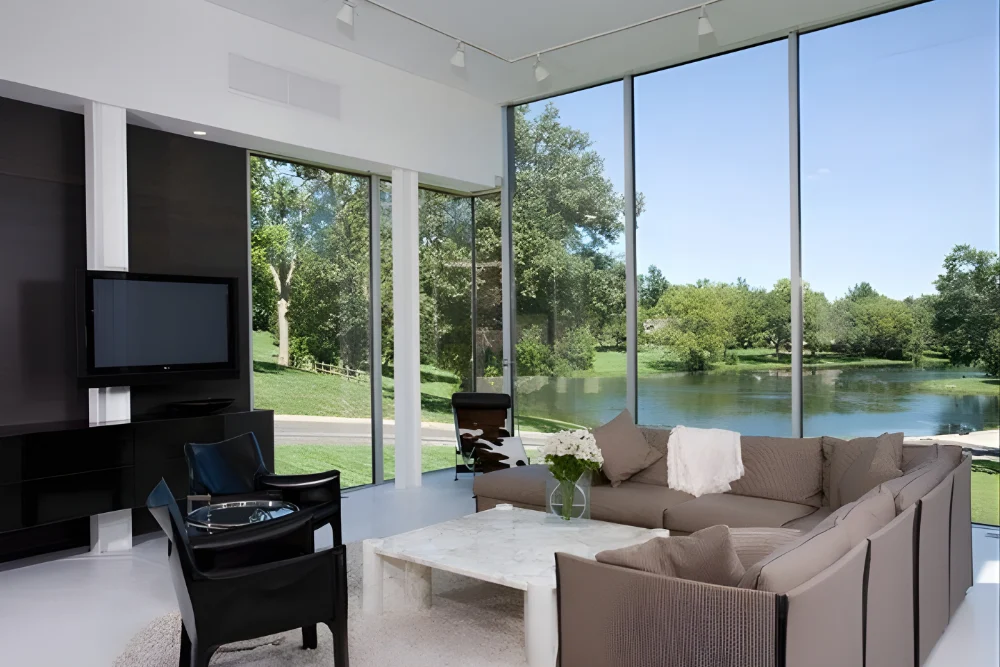
Most homeowners want the room cooler without it feeling like a cave. Lighter films with good heat rejection do that, and they keep the view. Every film we install blocks 99% of UV, which is what fades floors and furniture. Lift a rug that’s been down a couple of years and you’ll see it: a perfect rug-shaped patch of the floor’s original color.
Reflective film catches people out, because it’s a mirror on whichever side is brighter. Madico explains that after dark, with the lights on inside, anyone outside can see in clearly. Your living room turns into a lit stage, the street becomes the audience, and the film’s only job left is helping you check your hair on the way to the couch. For privacy at night, you need frosted or decorative film, or blinds.
If your house has west windows that cook a room every afternoon, see our home window tint in Nephi and home window tinting in Provo pages.
What we see on real jobs
Most people pick a shade from a photo online. Photos lie about tint, because the screen and the camera both adjust for brightness. It’s the same reason the burger never looks like the one on the menu board.
That’s why I bring the sunglasses case. You hold each shade up to your own window and decide. For a few minutes it does mean a grown man is handing your family sunglasses in the kitchen, but it beats guessing.
From the inside, it just looks very lightly tinted and from the outside you can’t see in.
Christi Evans, Google review, August 2026
A common worry with home film is losing daylight, because nobody wants to pay good money for a gloomier living room. Christi had that worry too: “I was really worried about the daylight still being able to come through and it absolutely can.” Afterwards, she felt the room drop by almost 10 degrees.
I’ve also replaced other installers’ film many times. Peeling off somebody else’s bad film is a lot like peeling a sunburn. It’s slow and oddly satisfying, and nobody else wants to watch. On cars, the job is in the detail, and Breann Ouckama noticed: “my car looks incredible, and you can tell they really pay attention to detail.”
Questions people ask
Is 10 percent tint dark?
Yes. 10% tint lets in only a tenth of visible light, so it looks almost black from outside. It’s close to limo tint. In Utah, it’s legal only on the rear side windows and back glass.
Is 35 percent tint legal in Utah?
Yes, on the front side windows, as long as the finished window meters at least 35%, with a 5% variance. Because car glass blocks some light, a 35% film can meter darker than 35%. Rear windows can be any shade.
Is 20 percent tint hard to see through at night?
It’s noticeably harder than 35%. A 1999 study found drivers of every age did worse at 20%. Most people manage it on the rear windows, but it isn’t legal on the front doors in Utah.
Does darker tint block more UV?
No. UV blocking depends on the film, not the shade. Quality films block 99% of UV whether they’re clear or limo dark.
Is ceramic tint worth it over regular tint?
For heat, yes. Ceramic film blocks much more infrared heat at the same shade. In one maker’s published figures, a ceramic 35 blocked 60% of the sun’s energy, against 35% for a non-ceramic 35.
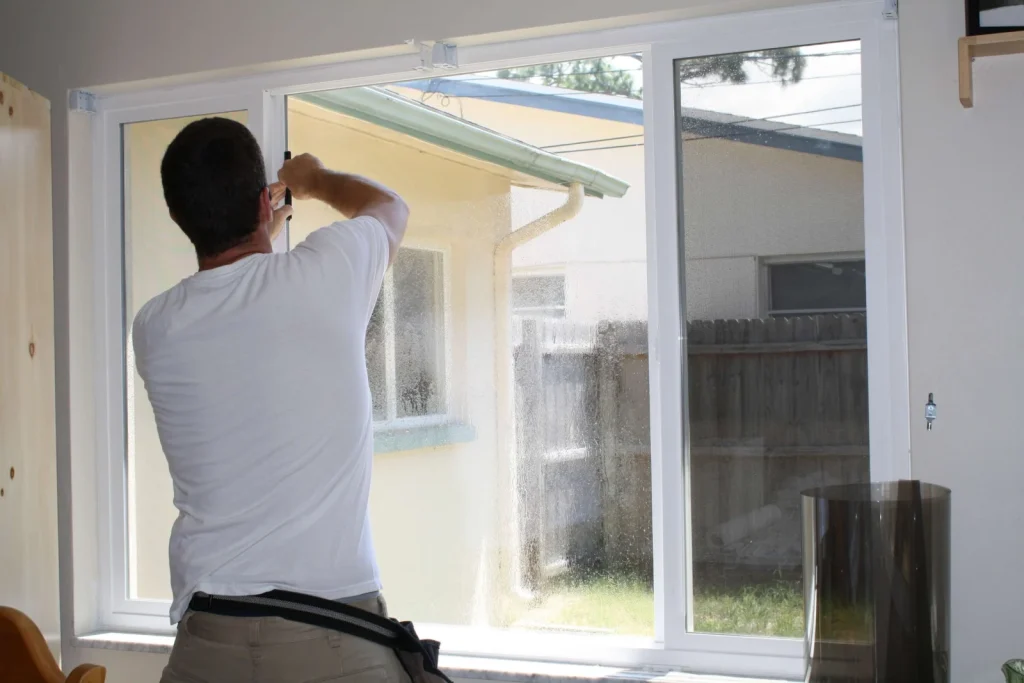
See the shades before you choose
We tint cars, trucks and SUVs at your home or work, and homes and businesses from Nephi to Provo. You get a free estimate, a custom quote within 24 hours, and the sunglasses case so you can see each shade first. Call Nephi on (208) 418-9869 or Provo on (385) 323-3165. The phones are answered 24 hours a day.
About the author: Keaton Haskell is the owner and lead installer of Nomad Window Tinting. He started tinting windows in Idaho Falls in 2022, moved the business to Utah, and is on every job.