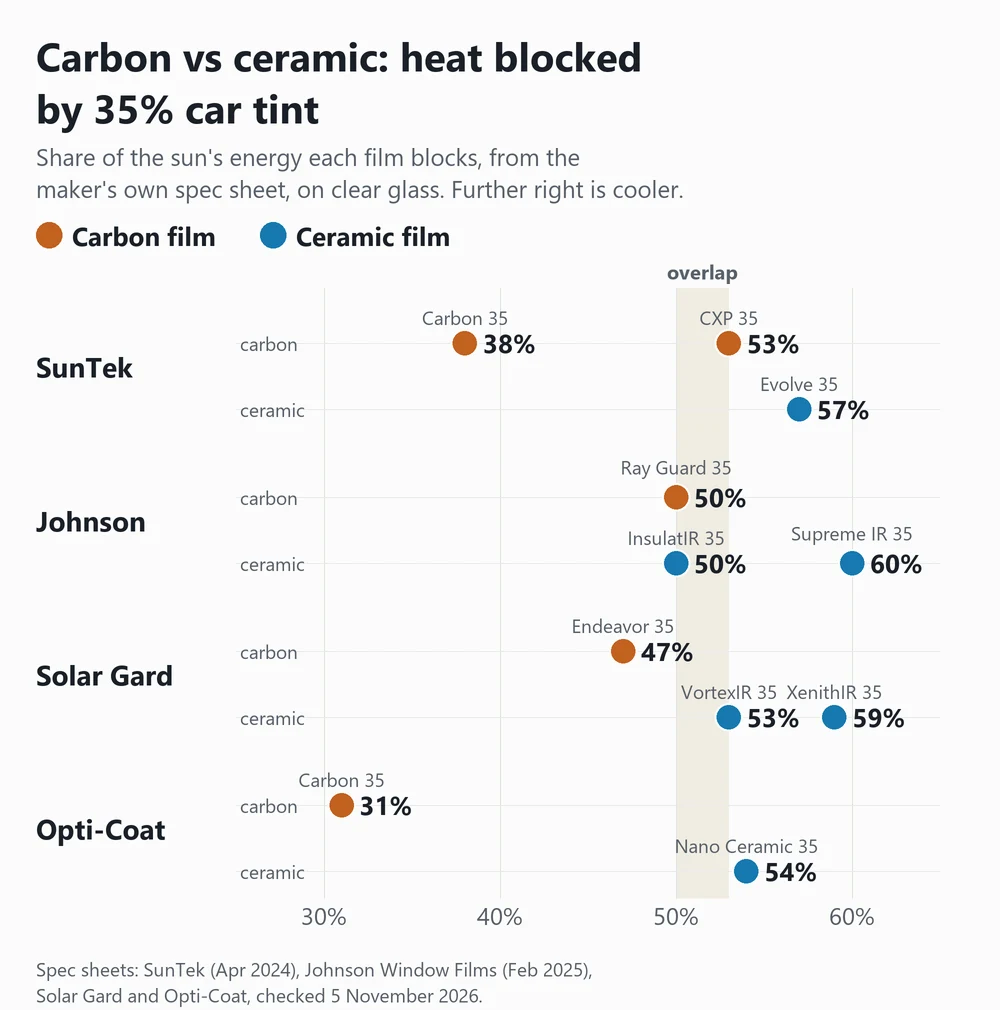
Quick answer: Ceramic tint blocks more of the sun’s heat than carbon tint at the same shade, because its ceramic particles soak up infrared. On the spec sheets of four makers that sell both, 35% ceramic films block 50% to 60% of the sun’s energy and 35% carbon films 31% to 53%. Both block 99% of UV, and neither fades or affects phone signals.
I’ve fitted window film on 300 jobs since 2022, from Nephi to Provo. On cars I fit two films, ceramic and carbon, so the question I hear most is which one, and whether ceramic is worth the extra. People usually ask it while tapping the dashboard with one finger, the way you test a stove somebody swore was off.
Below is the answer from the makers’ own spec sheets, shade for shade. Plus the number on the box that makes ceramic look about twice as good as it is. (The box isn’t lying, exactly. It’s just standing in very flattering light.)
On this page
- Carbon vs ceramic tint, compared
- What is ceramic tint?
- What is carbon tint?
- Which blocks more heat?
- Why “IR rejection” numbers look so big
- Dyed vs ceramic tint
- UV protection: a tie
- Can you see at night with ceramic tint?
- Phones, GPS and keyless entry
- Is ceramic tint worth it?
- What we see on real jobs
- Questions people ask
Carbon vs ceramic tint, compared
Here’s how the three main kinds of car tint compare at about 35%, Utah’s legal limit for front side windows.
| Carbon | Ceramic | Dyed | |
|---|---|---|---|
| Heat blocked | 31% to 53% | 48% to 60% | 35% to 36% |
| UV blocked | 99% | 99% | 99% |
| Shine | 5% to 6% | 5% to 7% | 6% |
| Fades? | No | No | Cheap ones can |
| Signal trouble? | No | No | No |
| Price | Middle | Highest | Lowest |
| We fit it? | Yes | Yes | No |
The heat ranges overlap, and most comparisons leave that out: a good carbon film can beat a basic ceramic one.
You were hoping for a one-word answer. Spec sheets don’t do those. They do nine columns and a footnote so small it’s basically a rumor.
What is ceramic tint?
Ceramic tint is window film with tiny ceramic particles built into it. The particles soak up infrared light, the part of sunlight you feel as heat, while letting most visible light through. That’s why a light ceramic film can block more heat than a dark film without them.
These aren’t the ceramics your aunt glazes into mugs on Thursday nights. The particles are far too small to see, which is good, because nobody wants a windshield with a drip pattern.
Infrared is about 53% of the sun’s energy, according to the International Window Film Association (IWFA). It’s the half of sunlight you can’t see but can absolutely feel, mostly through the back of your legs on a July car seat.
Ceramic doesn’t bounce heat away like a mirror. The IWFA says these films “work predominantly through solar absorption and not solar reflectance.” The film soaks up heat at the glass, so less of it reaches you.
The heat blocked by the tint ends up in the glass and partially re-radiating into the car. This, however is better than 100% of the heat inside the car.
A self-described engineer on r/WindowTint, November 2024
Hot glass, cooler you. I’ll take that deal.
What is carbon tint?
Carbon tint is window film made with carbon particles instead of dye. “Carbon films are manufactured with carbon particles rather than simple dyes,” as SunTek puts it. The carbon absorbs some heat and gives a deep matte black, more tuxedo than trash bag.
Carbon sits between dyed and ceramic. Most carbon films block more heat than dyed film, carbon doesn’t fade, and it costs less than ceramic. SunTek calls its CXP carbon “a perfect economical option to ceramic tint,” which is the politest way a company has ever said “the cheaper one.”
One YouTube reviewer, Peter von Panda, defended it well: carbon is “not the participation trophy of window tint.” It’s a real film that does a real job, just a slightly smaller one.
Which blocks more heat: carbon or ceramic?
Ceramic blocks more heat when you compare the same maker’s films at the same shade. How much more depends on the maker:
| Maker | Carbon 35 | Ceramic 35 | Gap |
|---|---|---|---|
| Opti-Coat | 31% | 54% | 23 points |
| SunTek | 38% | 57% | 19 points |
| Solar Gard | 47% | 53% to 59% | 6 to 12 points |
| Johnson | 50% | 50% to 60% | 0 to 10 points |
Carbon films vary a lot, from 31% to 53% at the same shade. That’s not a range. That’s two different films wearing the same name tag.
SunTek’s CXP 35 carbon blocks 53%, which beats LLumar’s CTX 35 ceramic at 48%. Johnson’s carbon and its InsulatIR 35 ceramic tie at 50%: same shade, same heat, different sticker.
You can get a Ceramic film that bubbles up in a year, or that blocks less heat than a Carbon film.
A window tint shop on r/WindowTint, October 2026
So “ceramic” on the box isn’t a promise. The TSER number is. Read it the way you read the label on anything sold as “healthy”: quickly, and with suspicion. If you’d like the bigger picture, here’s why a lighter film can be cooler than a darker one.
Why “IR rejection” numbers look so big
IR rejection numbers look big because many makers measure infrared over a narrow slice of light, where ceramic is strongest. The IWFA says the figure “is not defined in any national or international test method” and tells buyers to “always look for TSER first.”
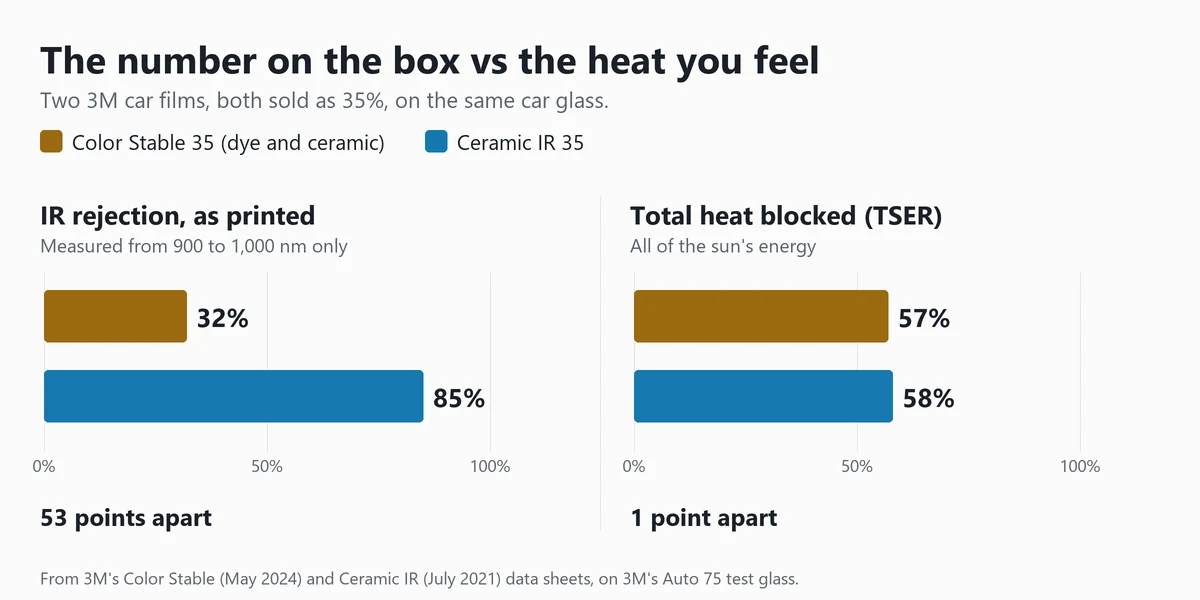
3M shows the trick clearly. On the same car glass, its Color Stable 35 lists 32% IR rejection and its Ceramic IR 35 lists 85%. But the total heat blocked is 57% against 58% (Color Stable sheet, Ceramic IR sheet).
3M’s IR figure only covers light between 900 and 1,000 nanometers. The 53-point difference exists mostly on paper, which is also where most of my New Year’s resolutions live.
Makers don’t even agree on what to measure. XPEL reports IR at a single wavelength, 1,025 nanometers (XPEL). Solar Gard measures 780 to 1,700 with a handheld meter (Solar Gard). Comparing their IR numbers is like comparing fish stories from three different lakes.
The IWFA puts it plainly: “an 80% IR rejection rating means you’re blocking 80% of the 53% of sun’s rays that are infrared.” Or as one car owner on r/WindowTint put it, those big numbers “are likely based on a narrower IR spectrum, which produce marketable percentages.” “Marketable percentages” might be the most honest phrase anyone has ever typed about window film.
Dyed vs ceramic tint
Ceramic blocks far more heat than dyed tint at the same shade. LLumar’s dyed ATC 35 blocks 35% of the sun’s energy, against 48% and 54% for its two ceramic 35s (LLumar). XPEL’s dyed PRIME CS 35 blocks 36%, against 59% for its ceramic XR PLUS 35 (XPEL).
Dyed film gets its color from dye, and cheaper dyes can fade over time.
Dyes can fade over time. We’ve all seen purple window tint
An installer on r/WindowTint, June 2025
We have. It’s usually on a car that also has a loose bumper, a coat hanger for an antenna, and a “Baby on Board” sign from a baby who’s now in college.
Plenty of dyed films are now sold as “color-stable” with a fade warranty. Carbon and ceramic get their color from particles, so fading isn’t how they fail. A Jeep owner with ten years of ceramic summed up the lifespan in a YouTube comment: “Being a Jeep, the engine blew up before the window tint did.”
The labels blur, though. 3M’s Color Stable uses “ceramic nano-technology and a patented dye technology” (3M), and some shops sell dyed film as “carbon.” Ask for the exact film’s name and shade, then look up its spec sheet.
UV protection: a tie
Carbon and ceramic films both block 99% of UV on every spec sheet we checked, and dyed films do too. On UV it’s a tie, like a soccer game between six-year-olds where everyone wins and gets orange slices.
That matters, because car side windows let a lot of UV through on their own. A 2016 study of 29 cars found windshields blocked 96% of UVA on average, but side windows only 71%, and one as little as 44% (JAMA Ophthalmology). Only 4 of the 29 side windows blocked more than 90%.
The best-known picture of what that does is a 69-year-old truck driver in the New England Journal of Medicine. His left side, the window side, “sat exposed to Ultraviolet-A sun rays for more than 25 years,” and his face shows it (Northwestern Medicine). A Stony Brook survey also found more non-melanoma skin cancers on the left side of the body, “except in patients who used automobiles with tinted windows” (Journal of the American Academy of Dermatology).
Can you see at night with ceramic tint?
Yes. At the same shade, ceramic and carbon let in the same visible light, so night visibility depends on how dark the film is, not what it’s made of. A 35% ceramic and a 35% carbon look about the same from the driver’s seat at night.
A shop owner with 12 years of tinting put it simply on r/WindowTint: “Ceramic is for heat rejection only.” It won’t help you see. It just won’t hurt either.
The shade does matter. In a 2000 study, a 37% film cut contrast vision for older drivers (Human Factors). City lights hide a dark tint, and rural roads find it.
One commenter on r/WindowTint told a suburban driver they could “get by with 15 on the sides, but I wouldn’t do that in the more rural area I live in.” Anyone who’s driven the canyon roads around Nephi at night knows why. Out there the only streetlight is the moon, and it isn’t trying very hard. Here’s how each tint percentage looks at night.
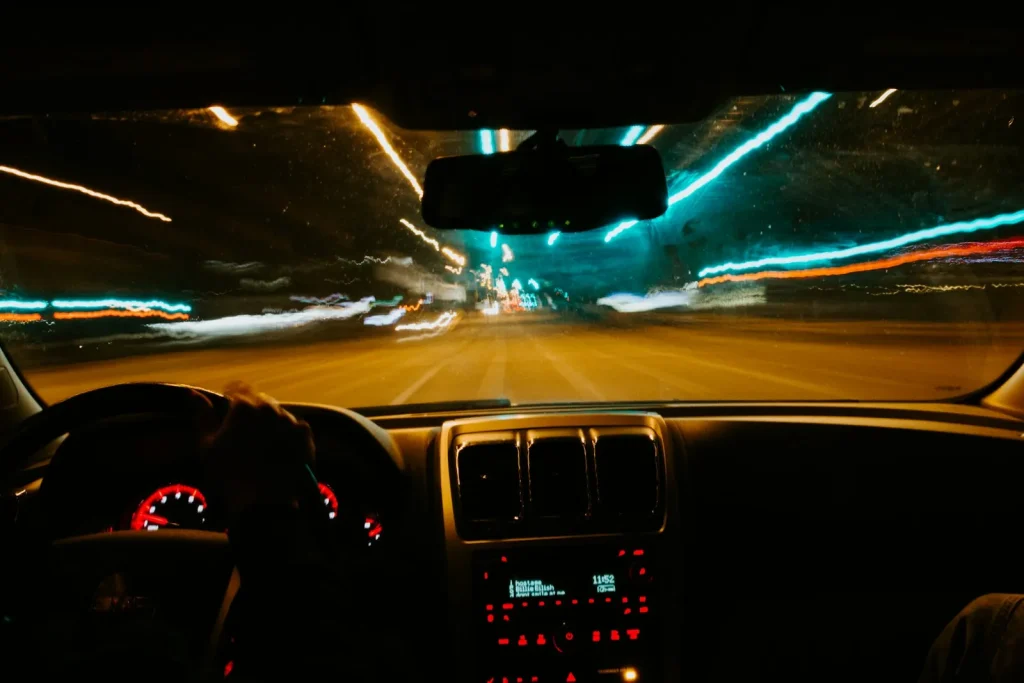
Phones, GPS and keyless entry
Neither carbon nor ceramic tint affects phones, GPS, radio or keyless entry, because neither contains metal. Solar Gard says its carbon and ceramic films “won’t interfere with mobile phones, GPS navigation, satellite radio, and other electronic devices.” A 2022 US government study found non-metal film doesn’t “interfere with radio frequency signals” (GSA). Your phone will get spam calls exactly as reliably as before.
Metallized films can, and they’re still sold. If a film is called metallic or reflective, ask.
Is ceramic tint worth it?
Ceramic tint is worth it if your car sits in the sun and you drive a lot in daylight. In Utah, that’s most cars. It’s less worth it if your car lives in a garage, you mostly drive at night, or you pick a strong carbon film.
One YouTube reviewer described the price gap as “a price difference that makes you wonder if one of them is made from actual unicorn tears.” Neither is. The extra pays for infrared rejection, which is less magical but works much better in July.
Utah sun is harder on a car than the thermometer suggests:
- Heat: July’s normal high is 95.2°F in Provo and 89.5°F in Nephi (NOAA).
- UV: Salt Lake City had 101 “very high” UV days in 2025, plus 2 “extreme” ones (NOAA).
- Altitude: UV rises 10% to 12% with every 1,000 meters, says the World Health Organization. Provo sits at 4,553 feet and Nephi at 5,132 (USGS), so by that rule of thumb they get roughly 14% to 19% more UV than at sea level.
Utah’s health department says the state has “one of the highest incidence rates of melanoma in the U.S.,” partly from “Utah’s higher elevation and high proportion of sunny days” (Utah DHHS).
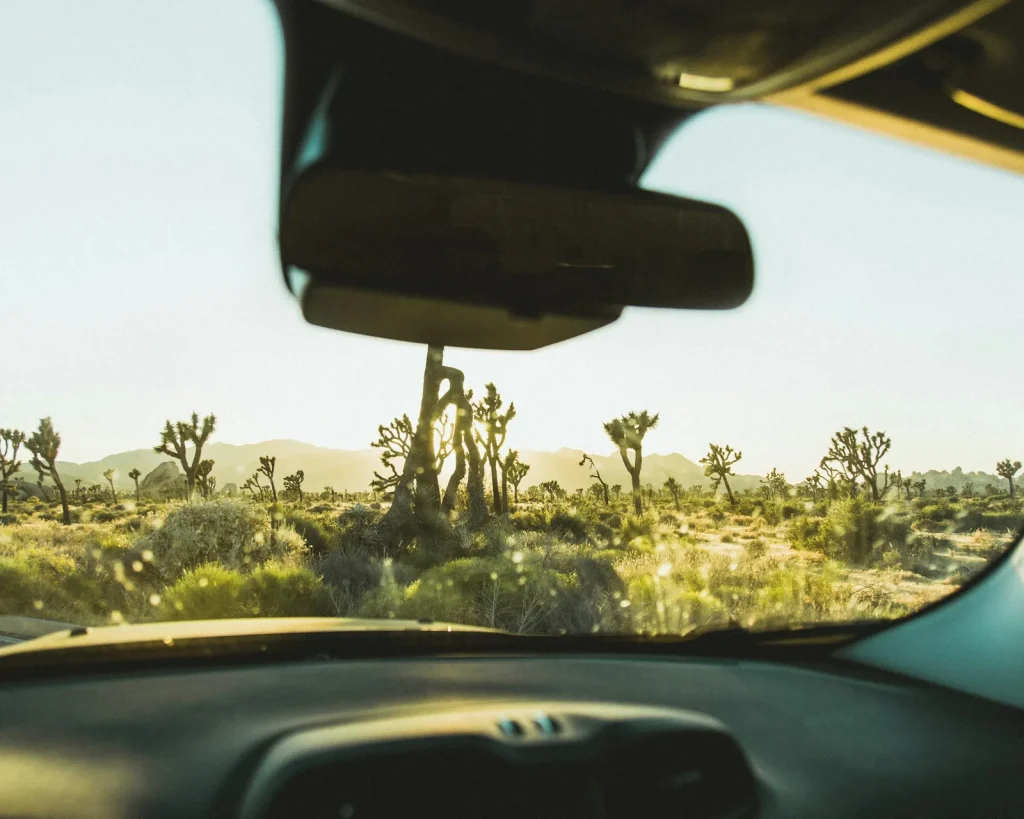
A parked car gets hot fast. Arizona State University parked cars in the sun on summer days over 100°F in Tempe. After one hour the cabin averaged 116°F, the seats 123°F and the steering wheel 127°F (ASU). That’s why every July driver spends the first mile steering with two fingertips, breathing through their teeth, and treating the seat belt buckle like a branding iron.
Tint slows that down. It doesn’t stop it. “Biggest misconception about ceramic tint is if you park in the sun the car will be cooler when you get in. Not true!” says a shop owner on r/WindowTint.
He’s right that it won’t be cool. It will be less hot, and it cools down sooner. In NREL tests run with 3M, a clear metal-free film on every window cut the air temperature at head height by 8.3°F in parked minivans, and the cabin reached 77°F almost four minutes sooner (NREL).
It is a better quality film, but it’s also a very good upsell.
A shop owner on r/WindowTint, May 2026
Both things are true. One owner with carbon on the side windows and a newer ceramic windshield wrote: “If I wasn’t so cheap I would redo the rest of the windows in ceramic” (r/WindowTint). Honest, and relatable.
Pick ceramic if:
- your car parks outside at work or home
- you drive a lot in the daytime
- you have a dark interior, kids in the back, or a dog
- you’ll keep the car for years
Carbon is a fine choice if:
- the car lives in a garage
- most of your driving is short, or after dark
- you want good heat control for less
Either way, ask for the TSER of the exact film and shade. A strong carbon can beat a weak ceramic.
What we see on real jobs
We fit ceramic and carbon films on cars, not dyed. We come to you, at home or at work, so your car gets tinted in your driveway while you do literally anything else.
I bring samples to estimates, including a case of big sunglasses, each with a different tint. You hold them up to your own windows and pick a shade before any film touches the glass. Yes, it looks a bit like I’m selling sunglasses out of a trunk. The film is the real thing.
The tint is smooth, even, and has completely transformed the look and comfort of my vehicle.
Breann Ouckama, Google review, May 2026
I’ve replaced other installers’ badly fitted film many times, and that’s the part no spec sheet covers. A great ceramic film fitted badly does worse than a good carbon film fitted well. Bubbles don’t care what the box said.
A common worry online is whether a shop really used ceramic. One YouTube commenter claimed “half the guys installing ceramic are installing carbon.” I can’t check that. The fix is easy: ask for the film’s name and shade before you pay, and look it up.
Questions people ask
Is ceramic tint worth it over carbon?
Usually, if your car sits in the sun. On four makers’ spec sheets, the gap at 35% runs from 0 to 23 points of the sun’s energy, in ceramic’s favor. If your car is garaged, or you pick a strong carbon film, the gap can be small.
Does carbon tint fade?
No. Carbon tint gets its color from carbon particles, not dye, so it doesn’t fade or turn purple. SunTek and Solar Gard back their carbon films with lifetime warranties against color change.
Is ceramic tint darker than carbon?
No. The shade is a separate choice. Both come in a range of shades, and a 35% ceramic film lets in about the same light as a 35% carbon film.
How long does ceramic tint last?
Many years. SunTek, Solar Gard and 3M all sell ceramic car films with lifetime limited warranties. Check what the warranty covers, such as color change, bubbling and peeling.
How can you tell if tint is ceramic?
You can’t tell by looking. Ask for the film’s brand, product name and shade, and check its spec sheet. A heat lamp or infrared meter test also shows the difference.
Is 35% tint too dark at night?
For most drivers, no. 35% is Utah’s legal limit for front side windows, and most drivers see out fine. Older drivers and anyone on unlit rural roads may prefer a lighter shade.
Get the right film for your car
We fit ceramic and carbon window tint on cars, trucks and SUVs at your home or work, from Nephi to Provo. You’ll see each shade on your own windows before we start, and we’ll tell you what’s legal. You get a free estimate and a custom quote within 24 hours.
Call Nephi on (208) 418-9869 or Provo on (385) 323-3165. The phones are answered 24 hours a day.
About the author: Keaton Haskell is the owner and lead installer of Nomad Window Tinting. He started tinting windows in Idaho Falls in 2022, moved the business to Utah, and is on every job.