Quick answer: No see-through window film gives privacy both day and night. One-way (mirror) film only works while it’s brighter outside than inside, so after dark, with your lights on, people can see in. For privacy around the clock, use frosted, decorative or blackout film, or switchable smart film, or pair one-way film with blinds at night.
I’ve fitted window film on 300 jobs since 2022, in homes and businesses from Nephi to Provo.
The privacy question always arrives the same way. Someone points at a bathroom window and asks, very casually, whether the neighbors will be able to see in at night. (Nobody has ever asked that question casually. Not once.)
The answer depends on the film. The one most people picture when they say “privacy film” is the one that fails after dark. Below are the numbers that explain why, a chart of Provo’s December evenings, and the Reddit post with 1,222 upvotes that every homeowner should read before buying mirror film.
On this page
- Privacy film types compared
- Does privacy window film work at night?
- Why one way window film stops working at night
- How many hours one-way film works in Utah
- The best window film for nighttime privacy
- Which film for which room
- What doesn’t work
- What we see on real jobs
- Questions people ask
Privacy window film for day and night, compared
Six kinds of film get sold for privacy, and only four of them can still work after dark. Here’s how each one does in daylight, at night with the lights on, and on the view.
| Film | Private by day? | Private at night? | See out? | Light let in |
|---|---|---|---|---|
| One-way mirror | Yes | No | Yes | About 15% |
| Dual-reflective | Yes | No | Yes, even at night | About 25% |
| Frosted | Yes | Yes, but a lamp can show shapes | No, just light | 73% to 86% |
| Patterned | Partly | Partly | Through clear parts | Varies |
| Blackout or whiteout | Yes | Yes | No | 0% to 10% |
| Smart film | Yes, when set | Yes, when set | When set to clear | Over 75% when clear |
Look down the “see out” column and you’ll spot the catch. Every film that keeps your view at night also keeps the street’s view of you. If somebody had invented the film that beats that, I’d be writing this from a boat.
Does privacy window film work at night?
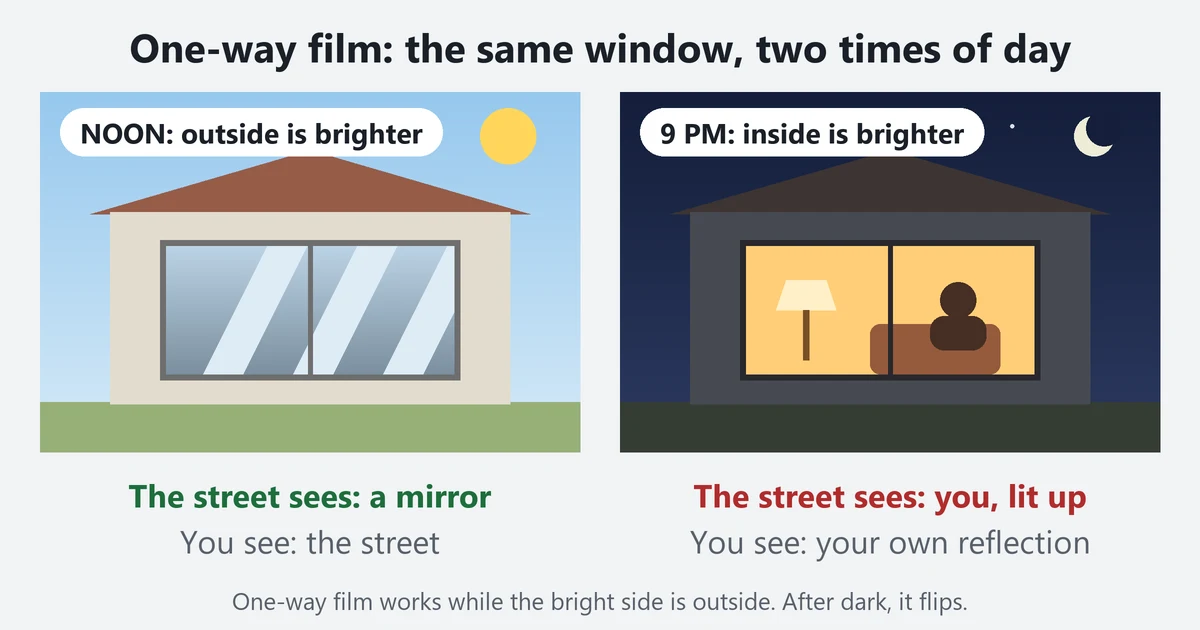
Privacy window film works at night only if it’s frosted, patterned, opaque, or smart film switched to private. One-way film doesn’t. It shows a reflection of whichever side is brighter, and at night the brighter side is your living room.
The numbers are almost a perfect flip. A gray overcast day is about 1,075 lux (Engineering ToolBox). A US Department of Energy lab measured real living rooms at night and got a median of 23 lux (PNNL, 2018). So even a cloudy afternoon is about 47 times brighter than your lit room.
Then the sun goes down. The same study measured the street light reaching a window at night, and the median was 0.5 lux. Now your living room is about 46 times brighter than the street. It’s the same deal, flipped around and pointed at your couch.
| Where | Light level |
|---|---|
| Direct sun | 107,527 lux |
| Overcast day | 1,075 lux |
| Twilight | 10.8 lux |
| Kitchen at night, lights on (median) | 104 lux |
| Living room at night, lights on (median) | 23 lux |
| Street light reaching a window at night (median) | 0.5 lux |
Pilkington, which makes one-way mirror glass, says the bright side needs to be at least 8 times brighter than the dark side for the mirror to work (Pilkington). In the day, outside wins by a mile. At night, your table lamp wins by a mile, and it isn’t even trying.
You already know this from your own kitchen. It’s why you can’t see the yard at 11 pm, and why you jump a little when you catch your own reflection in the window while rinsing a bowl. That reflection is what one-way film shows you all night. The street gets the other side: the best show on the block, and you’re the whole cast.
Why one way window film stops working at night
One way window film stops working at night because it was never one-way. It’s a thin metal layer that reflects light both ways, and you see a reflection from whichever side is brighter. At night that’s the inside, so you get a mirror and the street gets the view.
LLumar’s R20 silver film reflects 62% of visible light on the outside and 63% on the inside (LLumar spec table). The film doesn’t know which side you’re on. It’s a two-way mirror with a really good publicist.
Somebody on r/DIY found this out the classic way, in a post with 1,222 upvotes: “I added two way window film this afternoon and now that it’s dark it’s turned into a mirror, is this normal?” (r/DIY, April 2024). It is normal. One commenter found the bright side: “Bonus feature for identifying any vampires that are visiting you.”
You have created a police lineup mirror. At night you won’t know who’s looking in.
The top reply on r/DIY, with 5,745 upvotes, April 2024
Dual-reflective films, like 3M’s Night Vision line, cut the mirror on the inside. 3M’s NV-25 reflects 13% of light on the inside and 29% on the outside (3M spec sheet). That helps you see out at night, but it doesn’t stop the street seeing in. The name says “night vision,” and that’s exactly what you get: vision, at night, for everybody.
How many hours one-way film works in Utah
One-way film gives privacy while the sun is up. In Provo, that’s 15 hours 3 minutes on 21 June and 9 hours 18 minutes on 21 December (sunrise-sunset.org). On the shortest day, the sun sets at 5:04 pm and it stays dark for 14 hours 42 minutes.
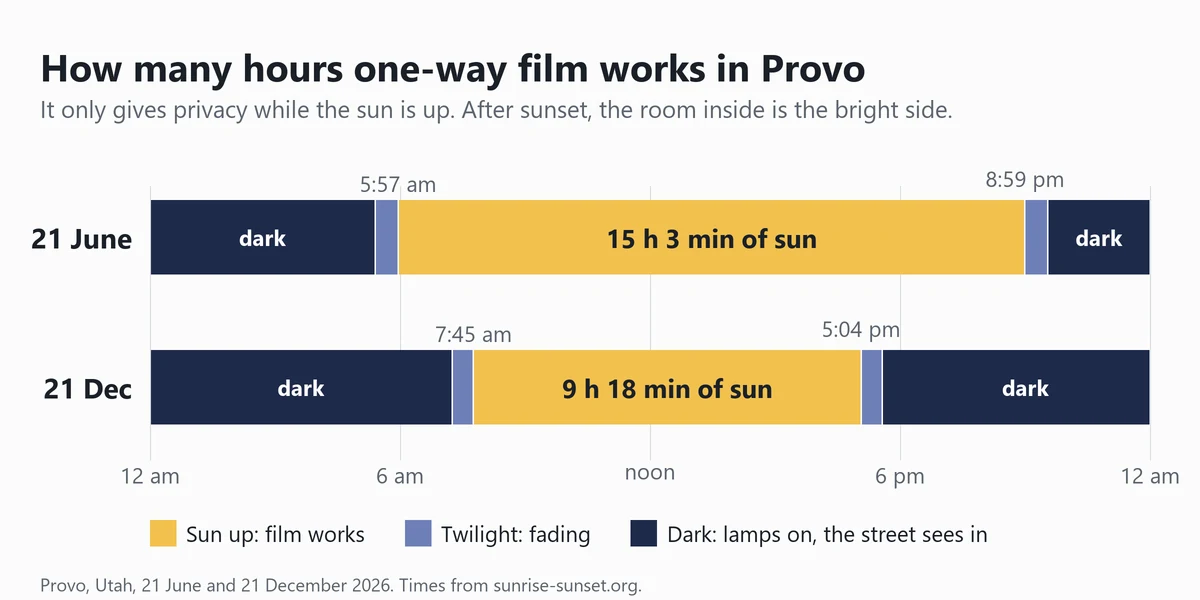
So in December, dinner happens after dark. If you get home at 5:30, your one-way film clocked out half an hour before you did, and it didn’t leave a note. Nephi is almost the same, with sunset at 5:06 pm on 21 December (sunrise-sunset.org).
There’s no grace period at dusk, either. Twilight is about 10.8 lux (Engineering ToolBox), and a lit living room at 23 lux already beats it. The flip happens while there’s still some pink in the sky over Utah Lake.
In June the film works until about 9 pm (sunrise-sunset.org), which is lovely. Bedtime still happens in the dark.
The best window film for nighttime privacy
The best window film for nighttime privacy is frosted film, because it blurs the view both ways in any light and still lets most daylight in. Blackout and whiteout film give total privacy but block the light. Smart film switches between clear and private when you tell it to.
Frosted film
3M’s Mat Crystal frost lets through 86% of visible light (3M FASARA data sheet), and clear glass with no film lets through 90% (LLumar). So you keep nearly all the daylight and lose only the view. LLumar rates its most popular frost 7 on a 0 to 10 privacy scale and says it gives “modest privacy.” That’s the most honest sentence a spec sheet has ever printed.
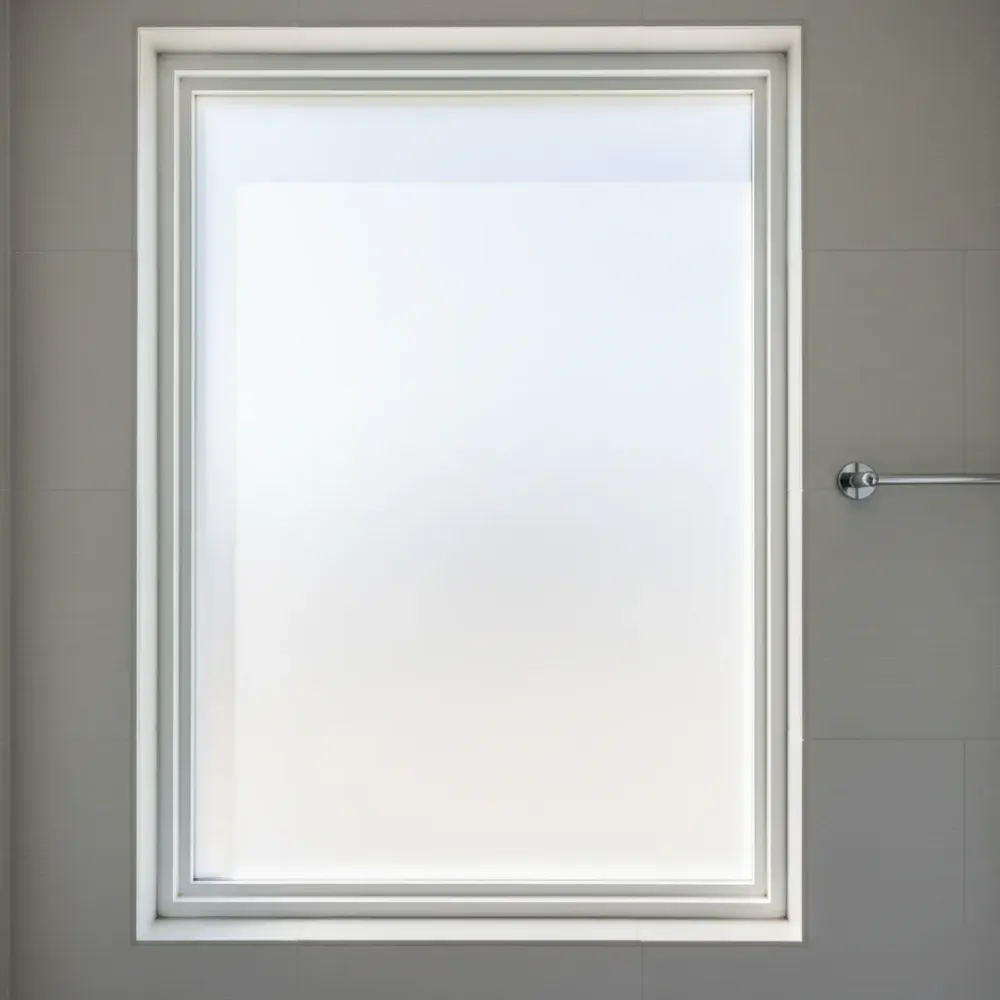
A light frost can still show a shape at night when someone stands between a lamp and the glass. A denser frost hides more. One homeowner on Houzz ran the test properly: “I had my son stand in front of the window, with the lights on, at night and you can’t see anything through it” (Houzz). We fit frosted film in Nephi and Provo, and the density is the part worth deciding in person.
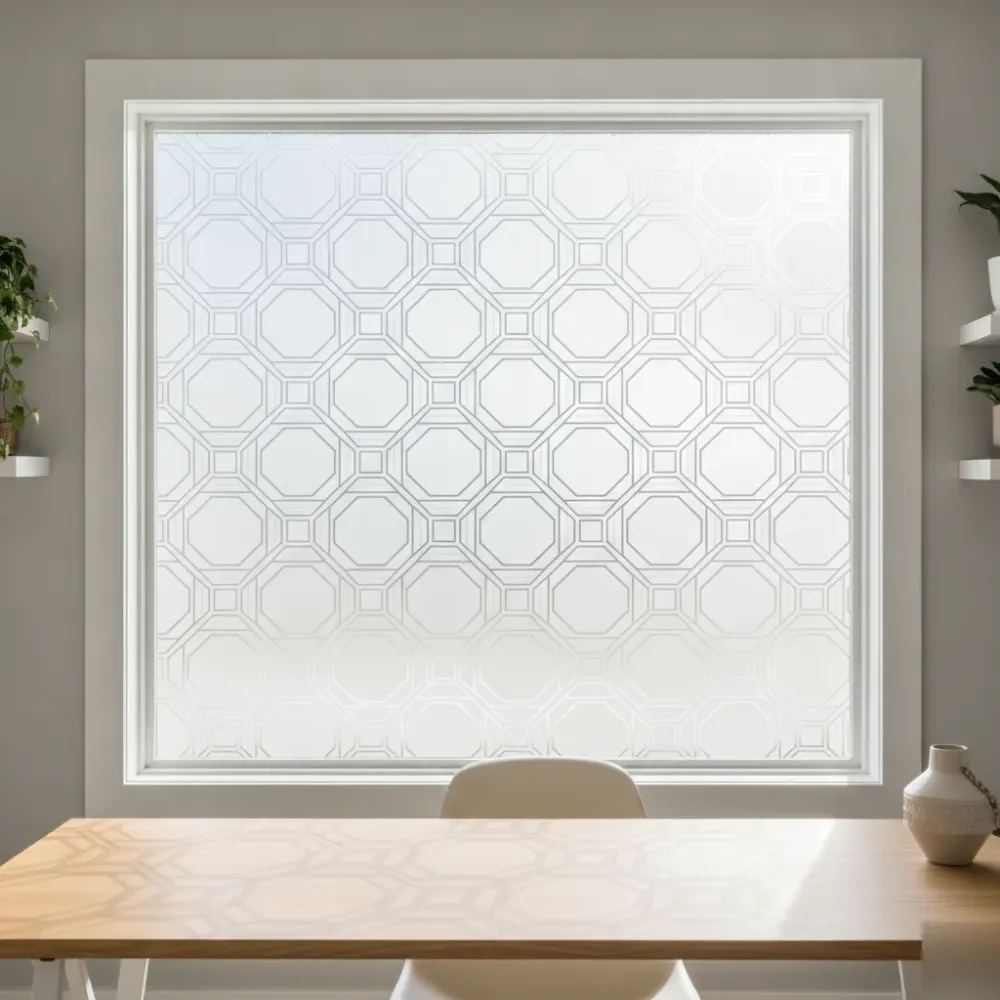
Decorative and patterned film
Decorative film hides part of the view with a pattern and leaves part clear. It’s private at night where the pattern is solid, and not where it isn’t. One Reddit owner of a rainbow patterned film said the neighbors “will be able to see the outline of your body but none of your bits” (r/interiordecorating, March 2024). That’s a fair review, if a little more detail than I wanted.
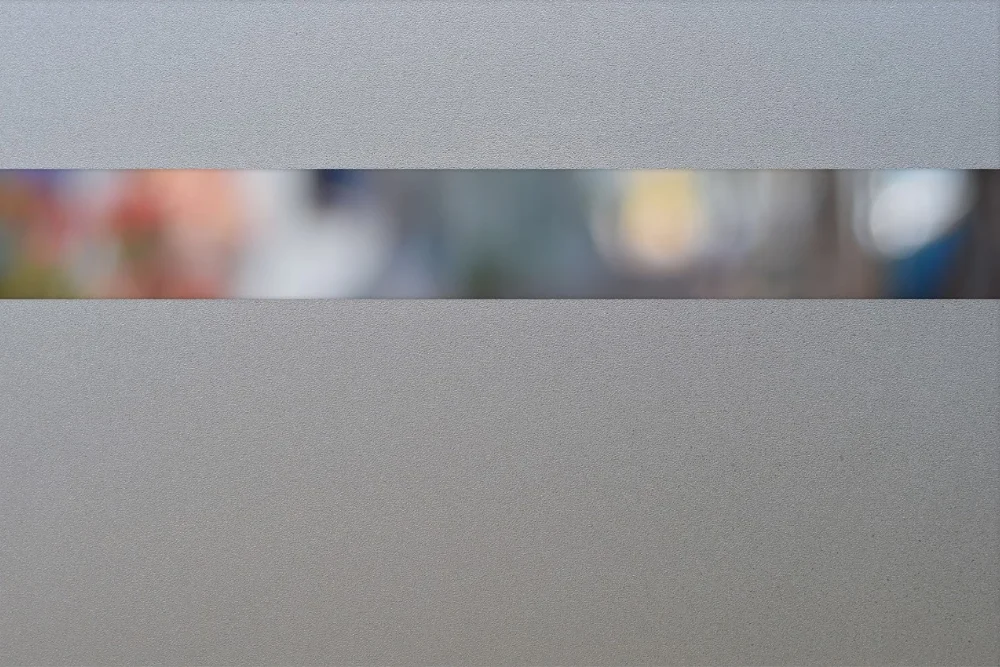
A popular fix is a frosted band: frost on the lower part of the glass, clear above, so you keep the sky and the treetops. As one r/HomeImprovement commenter put it, “You could frost a portion and leave a section bare, to let MORE light in” (r/HomeImprovement, October 2022).
Blackout and whiteout film
Opaque films block the view completely, day and night. 3M’s Opaque White lets through 10% of light and Opaque Black lets through 0% (3M FASARA data sheet). They suit a window where you need neither the view nor the light, like a basement window that looks into a window well and three very committed spiders.
Smart film
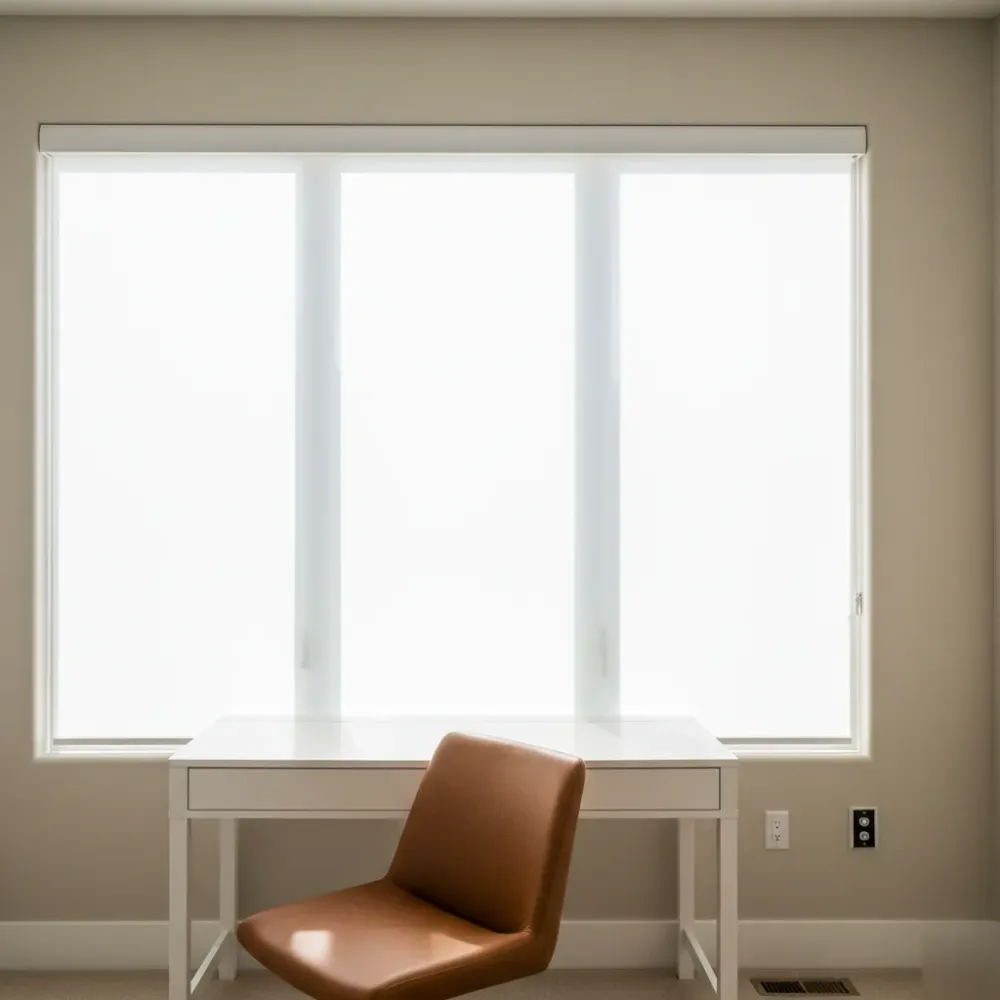
Smart film switches between clear and private at the flip of a switch. In clear mode it lets through over 75% of light with under 6% haze, and in private mode the haze goes above 97% (Polytronix). It needs power to stay clear, so it goes private when the power is off (Gauzy). Of all the ways a gadget can fail, “too private” is the one I’d pick.
Clear mode isn’t perfectly clear, though. One owner on r/homeassistant said “there is still a slight haze to it,” and added that with backlit monitors behind it, “it can sometimes look like a party’s going on from the outside” (r/homeassistant, July 2025).
Which film for which room
Pick the film by when the room gets used. A room you mostly use after dark needs a film that works at night. A room you use in daylight can keep the view with one-way film.
| Room | Day pick | Night pick | Why |
|---|---|---|---|
| Bathroom | Frosted | Frosted (go denser if a lamp sits near the glass) | You don’t need the view |
| Bedroom | Frosted or one-way | Frosted, or blinds over one-way | Night is when it matters most |
| Front door and sidelights | Frosted or decorative | Frosted or decorative | People stand right at the glass |
| Street-facing living room | One-way | Blinds or curtains at sunset | Keeps the mountain view all day |
| Kitchen window facing a neighbor | Frosted lower half, clear top | Same | You keep the sky |
| Home office | One-way or smart film | Smart film, or blinds | Covers day calls and late nights |
The living room is where I’d still pick one-way film. It’s the room where you want the view at 3 pm, and you’re happy to close the blinds at 9. For the bathroom, the bedroom and the front door, see our privacy window film in Nephi or in Provo and skip the mirror altogether.
Whatever you choose, do the street test once. Turn the lamps on after dark, put someone inside, and go and stand where the neighbors stand. One Reddit user suggests asking a friend “to sit on your bed one night so you can go down to the street and FaceTime to see what you can see” (r/femalelivingspace, February 2025). It takes five minutes and saves a very awkward chat over the fence.
What doesn’t work for privacy at night
Four fixes come up all the time, and none of them makes one-way film private after dark.
There is no such thing. What you want is impossible with film.
A glass and window film pro on r/HomeImprovement, April 2026
- A darker one-way film. It’s still a mirror on both sides. It’s just a moodier mirror.
- A second layer of one-way film. Two mirrors still show whichever side is brighter.
- Dual-reflective or “night vision” film. It’s made for seeing out at night, not for stopping people seeing in.
- Floodlights outside. To beat a 23-lux living room by 8 to 1, you’d need about 184 lux on the outside of the glass. The street usually manages 0.5. That’s not a porch light. That’s a used car lot selling sedans at midnight. One r/homedefense poster planned “privacy film and 10,000 lumen flood lights” anyway (r/homedefense, February 2025). Respect the commitment, but warn the neighbors.
Be wary of film sold as mirror film with “day and night privacy” on the box, too. Nothing about a box changes how light works.
What we see on real jobs
One-way film is at its best on buildings that are empty after dark. A dental office I tinted wanted more privacy for its patients, and dentists keep daylight hours, so the film is rarely asked to work a night shift. I said at the time it also “provides a nice reflection to check your hair before entering the building.” I stand by that.
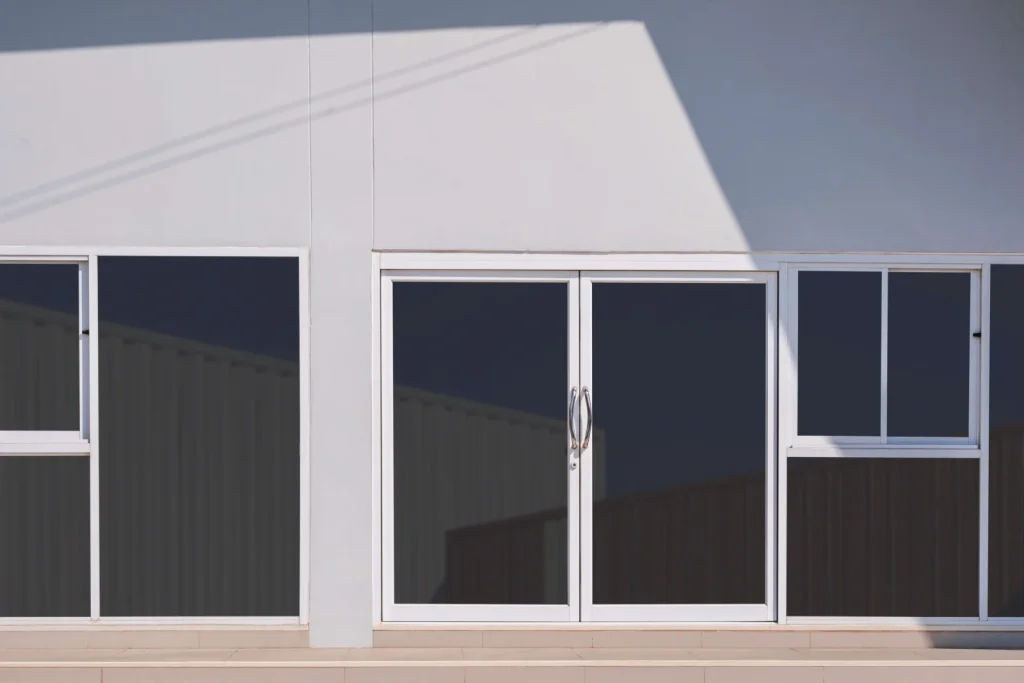
For homes, the reviews describe the daytime view exactly. Kathy H wrote, “The tint allows us the view outside and provides privacy.” Christi Evans in Provo wrote, “From the inside, it just looks very lightly tinted and from the outside you can’t see in.” That’s daylight privacy done right, and it’s the reason to pick one-way film for the rooms you use during the day.
Where people need privacy at any hour, smart film earns its keep. I’ve fitted it in offices near downtown Provo, in conference rooms by the Riverwoods area, and in home bathrooms. One switch, and the glass goes from window to wall.
The honest truth is there’s always a compromise.
A window film business owner on r/HomeImprovement, May 2026
That compromise is light, view or privacy, and you pick two. Pick the right two for each room, and the 9 pm show in your front window gets cancelled. The neighbors will have to go back to Netflix.
Questions people ask
Can people see through privacy film at night?
Through one-way (mirror) film, yes, if your lights are on and it’s dark outside. Through frosted, opaque or solid patterned film, no, though a light frost can show a shape when someone stands near a lamp. Smart film is private only when it’s switched to private.
Is there a one-way window film that works at night?
No. One-way film shows a reflection of whichever side is brighter, so at night with the lights on it reverses. Dual-reflective film reduces the mirror on the inside, but the street can still see in.
Does frosted window film let light in?
Yes. 3M’s Mat Crystal frost lets in 86% of visible light, against 90% for bare glass, and LLumar’s popular frost lets in 73%. You lose the view, not the daylight.
How do I make my windows private at night?
Use frosted, decorative, blackout or smart film, or close blinds or curtains after sunset. If you want one-way film for the daytime view, pair it with blinds at night.
Does one-way film work on cloudy days?
Yes. An overcast day is about 1,075 lux, still about 47 times brighter than a lit living room, so one-way film keeps working until the sun goes down.
Can you see out of frosted window film?
Not clearly. Frosted film blurs the view both ways, so you see light and shapes but no detail. Leave a clear strip at the top if you want to keep the sky.
Get privacy that works after dark
We fit frosted, decorative, privacy, one-way and smart film in homes and businesses from Nephi to Provo. Tell us which windows bother you at night, and we’ll show you which film covers them. You get a free estimate and a custom quote within 24 hours.
Call Nephi on (208) 418-9869 or Provo on (385) 323-3165. The phones are answered 24 hours a day.
About the author: Keaton Haskell is the owner and lead installer of Nomad Window Tinting. He started tinting windows in Idaho Falls in 2022, moved the business to Utah, and is on every job.